The counter iPad that gets your pharmacy paid.
Every funded service — found, billed, defended.
- +$60MedsCheck
- +$19Minor ailment
- +$8.50Flu shot
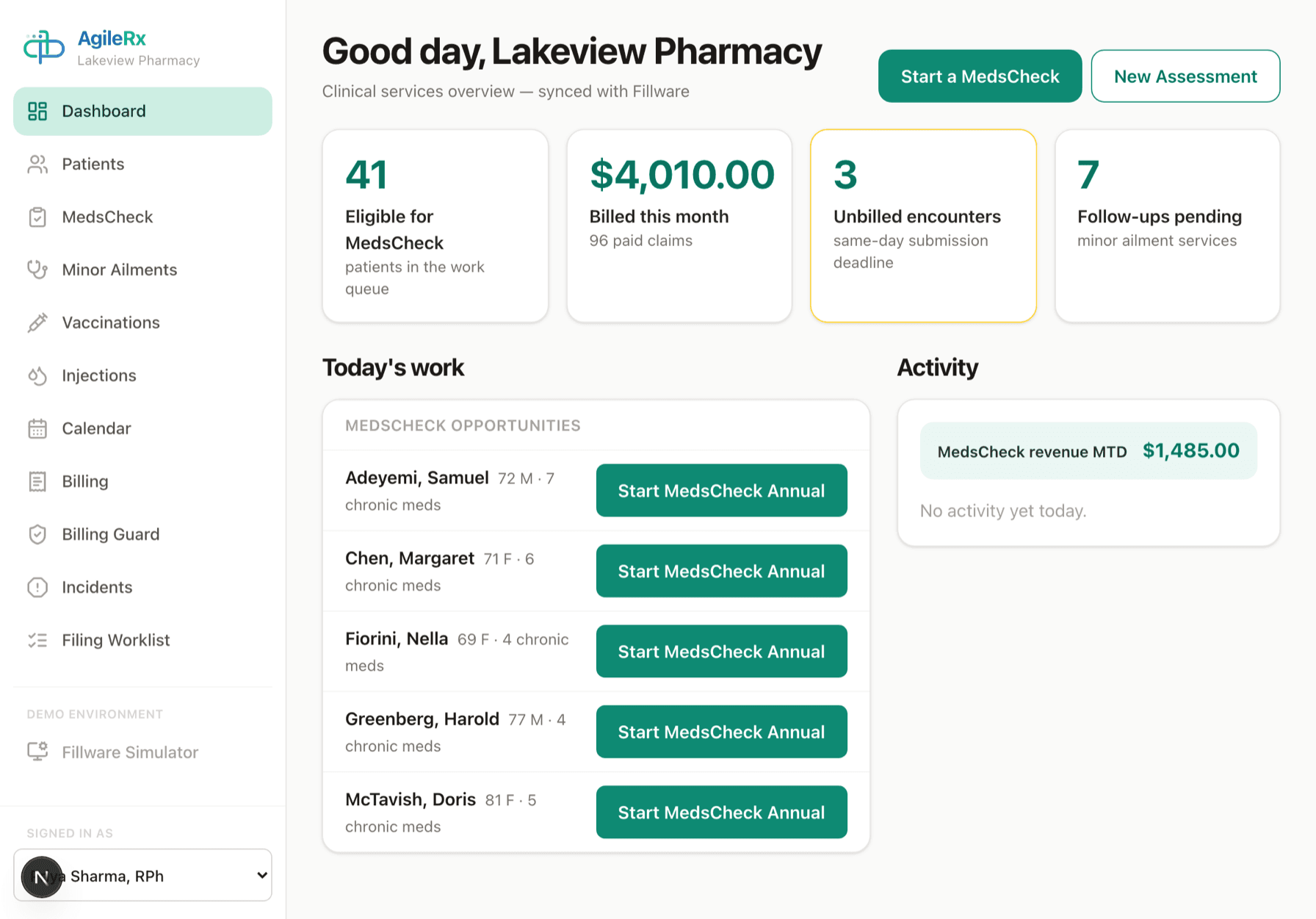
AgileRx on the counter iPad — the day’s eligible patients, already queued. Product screenshot, sample data.
What you’re losing
What you pay to stop it
$149a month — the whole platform, about three MedsChecksWhy a device, not a process
Without it, the work does not get done. That is what costs you.
Nobody decides to skip a MedsCheck. It just never surfaces, or the paperwork lands at closing, or the claim misses its window — so the store does the bare minimum and the money it had already earned quietly never arrives.
On paper, or not at all
Nobody knows who qualifies
Eligibility is buried in the dispensing profile — three distinct chronic DINs, no annual in 365 days. Checking that by hand, patient by patient, is not something that happens on a busy Tuesday.
The documentation is the job
Ministry forms, filled from memory after the patient has gone. It is the part everyone dreads, so the service gets skipped — or done, and never written up well enough to survive a verification.
The claim goes late, wrong, or never
The right PIN of four, the same-day deadline, the prohibited same-day combination. Miss one and the claim is rejected, or paid and clawed back a year later.
The bare minimum. Money you had already earned, left behind.
On the counter iPad
The queue tells you who qualifies
The eligible patients are surfaced before you open — named, with their chronic-med count, and a button that starts the review. No hunting, no judgement call.
The record writes itself as you go
Documented in the encounter, on the ministry forms, beside the patient — not reconstructed at closing. The record that gets built is the one an audit asks for.
The claim files under the right code
The right PIN, the right fee, inside the window — and Billing Guard checks it before it goes and defends it after it is paid.
The service actually happens — and it gets paid.
The product
Seven modules. One clinical day.
Teal earns. Blue protects. Every module is built against a published fee schedule or a published standard — the numbers on these cards are the ministry’s and the College’s, not ours.
MedsCheck
Finds every eligible patient, runs the review on the ministry forms, and bills it without clawback risk.
$60Annual$25Follow-upExploreMinor Ailments
All 28 funded conditions — eligibility, red flags, the legal formulary, and the right PIN of four.
$19In person$15VirtualExploreBilling Guard
Catches what HNS would reject before you submit — and the documentation gaps that lose a verification after you are paid.
LOBenefit maximumA3Same-day duplicateExploreVaccinations
Flu, COVID and the new Adult Vaccine Bundle through one DIN-based claims pipe, with the pharmacist gate enforced.
$8.50Influenza$13.00COVID-19ExploreMedicine Injections
The stickiest recurring visit a pharmacy runs — with the two authority lanes and the dosing window modelled properly.
noneOntario public fee$11.41British Columbia paysExploreIncident Reporting
Built to the OCP Platform Criteria, with anonymous daily NIDR upload. This is the module the law requires.
15Mandatory fieldsdailyNIDR uploadExploreAppointment Calendar
One surface for the clinical day — bookings and the follow-ups the system generated for you.
30 minMedsCheck15 minMinor ailmentExploreThe money
Ontario publishes what it pays.
Every figure below is a line in the Ontario Drug Programs Reference Manual or an Executive Officer Notice. None of it is a projection, and none of it is ours. AgileRx finds the eligible patient, runs the encounter on the ministry forms, and files the claim under the right code.
| Service | Line | Fee | Reference |
|---|---|---|---|
| MedsCheck | Annual | $60 | PIN 93899979 |
| Follow-up | $25 | four PINs by trigger | |
| Diabetes Annual | $75 | PIN 93899988 | |
| At Home | $150 | PIN 93899987 | |
| Minor Ailments | In person | $19 | — |
| Virtual | $15 | — | |
| Funded conditions | 28 | as of Jul 1, 2026 | |
| Claims, 2023–24 | 1.47M+ | province-wide | |
| Vaccinations | Influenza | $8.50 | per dose, UIIP |
| COVID-19 | $13.00 | per dose | |
| Medicine Injections | Ontario public fee | none | Ontario funds vaccine administration only |
| British Columbia pays | $11.41 | per administration | |
| Typical private fee | ~$20 | configurable |
The Pharmacy Adult Vaccine Bundle opened on July 1, 2026 with no published administration fee. AgileRx holds those claims and releases them the day a fee is announced — it does not guess a number, and it will not let you submit into the dark.
Ontario funds vaccine administration only. It pays nothing for a B12, a Depo-Provera or a long-acting antipsychotic injection, while British Columbia pays $11.41 for the same act. Those visits run as a private service — and they are the most reliable recurring appointment in the store.
Fees and PINs: Ontario Drug Programs Reference Manual; Executive Officer Notices (UIIP, COVID-19, minor ailments expansion). Claims volume: Ontario minor ailments, 2023–24.
And then there is the law
The one platform you are forced to buy.
Everything above, you earn whether the rules change or not. But they did change. From January 1, 2027 the College’s supplemental standard makes a medication incident platform a condition of accreditation — every Ontario pharmacy has to own one. The only question left is whether it also runs your MedsCheck and defends your claims. For a single-purpose incident tool, the answer is no.
- Who it binds
- Every accredited pharmacy in Ontario — roughly 4,500+ of them — on the same day. There is no phase-in by store count and no exemption for a quiet dispensary.
- What it requires
- A platform that meets OCP’s published Platform Criteria, captures the 15 mandatory fields for a medication incident (14 for a near miss, which never reached the patient), and uploads the anonymous record to the National Incident Data Repository daily.
- What it pays
- Nothing. Incident reporting is a cost line with no fee code behind it. Which makes the only interesting question this one: what else can the platform you are forced to buy actually do?
- Where AgileRx sits
- Built directly to the published OCP Platform Criteria. OCP does not certify, approve or endorse any platform — nobody can honestly tell you otherwise, and we won’t.
No rip and replace
It runs beside your dispensing system. It does not replace it.
Nobody is pulling out the software that fills prescriptions, and no pharmacy team will trade a dispensing workflow they know for a promise from a vendor. So AgileRx never asks them to. Your dispensing system keeps the dispensing record. AgileRx keeps the clinical record, the claim, and the incident file.
It works with no integration at all
Assisted worklist mode is the default, not the fallback. A pharmacist works the AgileRx worklist on an iPad while the dispensing system carries on untouched. No adapter, no data migration, no go-live weekend, no downtime you have to explain to a line of patients.
Designed to integrate with Fillware
The adapter is on the roadmap, not in the box — we will not tell you it is finished when it is not. When it lands, patient and medication context flows in on its own. Until it does, nothing about AgileRx is waiting on it.
iPad-first, because the encounter is not at the fill counter
A MedsCheck happens in the consultation room. An assessment happens across a counter from a patient who is standing up. An injection happens at the chair. The software goes where the clinical service actually happens.
See it against your own numbers.
Thirty minutes, on your services and your volumes. We will show you the MedsCheck eligibility engine, what a minor ailment assessment looks like on the counter, and the AIMS module against the published criteria.